Archive for November, 2009

30 Second Elevator Speech

Have you practiced your 30 second elevator speech?

The concept of an elevator speech is that you happen to get on an elevator just as a potential client is also getting on the same elevator. You are riding up only one floor together. While the doors are closed, you have 30 seconds to make a convincing sales pitch.  Those 30 seconds are all you have to convince your potential client to consider your business for future work.

A 30 second elevator speech is not a sales call and is not designed to gain clients’ immediate business.  Instead, an elevator speech should be conversationally designed to help potential clients remember your name and call you back, with interest, at a later time.

Though you probably don’t often encounter your potential lawn care clients in an elevator, you may encounter them at coffee shops, post offices, and in line at the bank.

If you had only 30 seconds to convince a client to use your services, what would you tell them?

Introduction:

Introduce yourself and your company.  A firm handshake with your first name will suffice here.  A good looking shirt with your lawn care company’s name and logo will help you sidestep repeating your company name at this point.

Expertise – Special Equipment

What sets your company apart from the rest of the lawn care companies in your community?  Without making your sales pitch sound like a sales pitch, entice your client by relaying specialized knowledge about a particular lawn care problem you are currently researching or by bragging on a specialized piece of commercial lawn care equipment.  

When leaf raking season rolls around, I like to carry flyers and pictures of my leaf collection equipment.  Leaf blowers are cool and even people who are disinterested in lawn care like to look at commercial leaf blowers in action.

Everyone knows what a lawn mower looks like but not many people are familiar with commercial leaf blowers that can move 800 cubic feet of leaves per minute.  They are impressive and anyone with a yard full of leaves will be interested in the ability of such a machine.  Knowing my company has the equipment to handle such a job keeps my name in potential customers’ minds.

Quick Exit – Leave Them Wanting More

An elevator speech should be 30 seconds or less and 130 words or less.  Nothing is worse than a salesperson who kills a potential sale by rambling on and on.  If you are truly in the elevator, hand them your business card and exit as soon as you reach your floor.  Remember, you are not trying to close the sale here, you are only trying to pique their interest.  If they are interested in having you visit their residence for an estimate, get their name, address, and phone number.   

I would love to hear your elevator speech.  If you have never written a 30 second elevator speech, write one now and leave it in the comments section below.
Tags: , , ,

Your Lawn Care Business and Code Orange Days

Air quality issues increasingly impact Lawn Care Business owners.

I am writing this blog post looking through my window on a crystal clear November morning. The sky is colbalt blue and distant Tennessee mountains appear close enough to touch. There is a slight breeze and the frosty morning air is brisk and fresh.

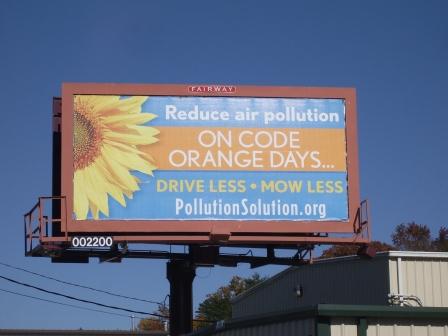
Though crisp November mornings distance me from the thoughts of smoggy Summers days, a billboard I saw this morning forced me to realize the effects air pollution has on our industry.

code_orange

Billboards and other Public Service Announcements have popped up in recent months throughout the southeast. These announcements encourage us to drive less and mow less on Code Orange days.

A Code Orange alert is announced when air pollution is predicted to reach unhealthy levels for sensitive groups. Typically, code orange levels are between 101 and 150 on the air quality index.

Lawn care equipment produce high levels of carbon monoxide, volatile organic compounds, and nitrogen oxides. Two-cycle equipment such as weedeaters and leaf blowers are particularly high polluters. Oil mixed with gasoline causes very high levels of particulates released in exhaust fumes.

As air quality regulations begin to restrict our movements as an industry, opportunities are created which allow us to become an environmentally sensitive industry.

At recent lawn care trade shows, I am continually impressed to see equipment manufacturers furthering their research into low-polluting machines. The largest progress is being made with propane powered string trimmers and lawn mowers.

Propane powered lawn equipment dramatically reduces the air quality lowering effects of traditional commercial lawn mowers and two-cycled weedeaters and leaf blowers. As manufacturers produce higher quality and lower priced propane powered lawn equipment, our jobs of remaining EPA compliant will become easier.

Lawn care companies that begin the process of upgrading their equipment to propane power will find themselves in unique positions of being able to continue to operate their businesses during code orange days.

Next time you see a billboard reminding you not to mow on Code Orange days, think of it not as a restriction to your lawn care business but as an opportunity for you to distance yourself from your competition.

The “Start A Lawn Care Business” guidebooks, estimating software, and training videos will help you run a better lawn care business.
Order your copy at: http://www.StartALawnCareBusiness.com

Tags: , , ,

Ethanol Gasoline in Small Lawn Mower Engines

Does ethanol damage lawn mower engines?

As lawn care business owners, we strive to provide proper maintenance for our lawn equipment. Equipment engine oil is changed regularly. Air filters are cleaned and/or replaced when they become dirty. Lubrication is performed on schedule as outlined in owners’ manuals.

In addition to routine maintenance, there are many other tips we can follow to help extend lawn equipment life. We cover many tips within the pages of our Lawn Care Business Guidebooks.

One of the simpler actions we can take, on a daily basis, is use of high quality gasoline. High quality does not necessarily mean high octane. High quality, in many people’s opinion, means a lack of impurities.

There is a gas station not far from our business location that charges a few cents per gallon less than competing station. However, the gas station is more than 40 years old and it looks dilapidated. A gas station in such poor condition makes us wonder about the condition of their fuel tanks. If their tanks are corroded and contain residue from years of being underground, could those impurities find their way into our gas tanks?

Though ethanol is not considered an impurity to industry insiders, many small engine mechanics speak up about damage caused by ethanol. According to an MSNBC article on damage to small lawn mower engines caused by ethanol in gasoline ethanol attracts moisture which prevents oil within lawn care equipment from doing its proper job. This moisture reacts with rubber and plastic fittings and hoses. As these parts deteriorate, they may clog openings within the engine and can cause a shellacking on pistons resulting in reduced lubrication. All this is according to small engine experts.

Don’t rely strictly on experts though, read the many comments in this blog from www.TheTruthAboutCars.com dealing with the hazards of using ethanol blended gasoline in many different types of engines.

In the southern states where we live, 10% ethanol has been a fact of life since early 2008. Though we have heard horror stories of damage done by ethanol, we rarely have a choice other than to use an ethanol gasoline blend.

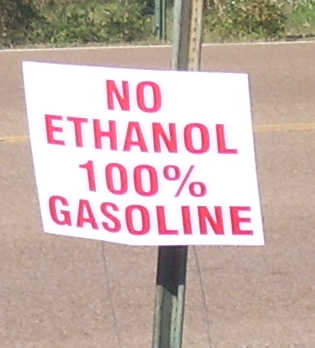
Times are beginning to change, though, and we see signs that gas stations are offering 100% gasoline again. In fact, a brand new gas station with brand new tanks, less than half a mile from the old dilapidated gas station offering 10% ethanol, has just opened. This new gas station does not add ethanol and offers pure gasoline.

noethanol

Ahh…no contamination and no ethanol. Our lawn mowers and two-cycle leaf blowers, weedeaters, and other lawn care equipment will run “clean” once more.

For more information on dealing with commercial lawn mower questions as well as running your own lawn care business, visit our website: www.StartALawnCareBusiness.com